Mars Lost Its Shield?

Mason O'Donnell
| 15-08-2026
 · Science Team
Greetings, Lykkers! Imagine Mars billions of years ago, with rivers carving valleys and lakes filling ancient basins. A vast body of water may have even covered much of its northern lowlands.
So, where did all that water go? A key clue lies deep inside Mars, where changes in its core weakened its magnetic field, leaving the planet exposed to solar wind that gradually carried away much of its atmosphere and water.
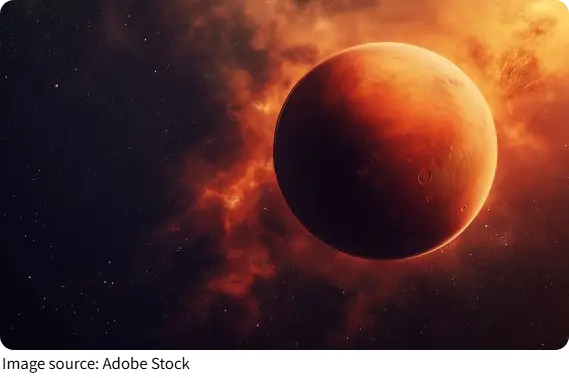
Mars Was Once Far Wetter Than It Is Today
Modern Mars is cold, dry, and covered with evidence of an ancient environment shaped by flowing water. Features such as valley networks, ancient lake basins, deltas, and sedimentary deposits indicate that liquid water once moved across parts of the planet.
Scientists studying Martian geology have found particularly strong evidence in regions where rivers appear to have emptied into standing bodies of water. Some geological models suggest that Mars may have hosted a substantial northern ocean during its early history, although the exact size, depth, and persistence of that ocean remain subjects of scientific debate. The timing is also important.
Much of the evidence for flowing water dates to the Noachian period, roughly 4.1 to 3.7 billion years ago, when Mars was considerably different from the planet we see today. Mars did not simply run out of water overnight. Its transformation was probably a long process involving atmospheric loss, climate changes, freezing, chemical reactions, and the gradual removal of water from the surface environment. One major factor may have been the disappearance of its global magnetic field.
Why a Planet Needs a Magnetic Shield
Earth's magnetic field is generated by movement within its electrically conducting outer core. That magnetic environment extends far beyond the atmosphere and interacts with the solar wind, a continuous stream of charged particles flowing outward from the Sun.
Mars once appears to have possessed a global magnetic field as well. Today, however, spacecraft detect strong magnetization preserved in parts of the ancient Martian crust rather than a planet-wide magnetic shield like Earth's. That ancient magnetization is important because it indicates that Mars had a dynamo - an internal process capable of generating a global magnetic field - early in its history.
When the dynamo shut down, Mars lost much of this protection. The magnetic field did not directly hold oceans in place like a physical lid. Instead, it helped reduce the direct interaction between the solar wind and the upper atmosphere. Once the global field disappeared, atmospheric particles became more vulnerable to being carried away into space.
What Happened Deep Inside Mars?
The connection between Mars' interior and its surface climate may seem surprising, but planetary evolution is closely tied to what happens inside a planet. A 2022 study led by researchers at the University of Tokyo investigated a possible explanation involving the chemical behavior of Mars' core. Scientists have proposed that the Martian core contains large amounts of iron along with lighter elements such as sulfur and hydrogen.
To examine how these materials might behave under Martian core conditions, researchers recreated extreme pressure and temperature conditions using a diamond-anvil setup and laser heating. Their experiments suggested that an iron-sulfur-hydrogen mixture could separate into different liquid compositions under relevant conditions.
One liquid would be richer in iron and sulfur, while another would contain more iron and hydrogen. Because the compositions have different densities, the separation could produce movement within the liquid core. That movement matters because convection in an electrically conductive fluid can help generate a planetary magnetic field.
A Magnetic Field Can Depend on Core Movement
Early in Mars' history, chemical separation inside the core may therefore have contributed to convection and helped sustain a dynamo. But a dynamo requires continued internal motion. If the core eventually became chemically stratified, the vigorous circulation needed to maintain the magnetic field could have weakened or stopped. Once the dynamo ceased operating, Mars no longer had a strong global magnetic shield.
This does not mean the magnetic field vanished at one precise moment and the oceans immediately disappeared. Planetary evolution is considerably slower and more complicated. Instead, the shutdown of the dynamo may have removed an important layer of protection while other atmospheric and climatic processes continued transforming Mars.
The Solar Wind Gradually Changed the Atmosphere
With no global magnetic field, the upper atmosphere of Mars became more exposed to the solar wind. NASA's MAVEN mission has provided direct evidence that the solar wind is actively removing particles from the Martian atmosphere today. Measurements show that atmospheric ions can be accelerated away from Mars through interactions with the solar wind and the planet's induced magnetic environment.
Over geological timescales, this atmospheric erosion can make a major difference. As Mars lost atmospheric gases, surface pressure declined. A thinner atmosphere made it increasingly difficult for liquid water to remain stable on the surface. Water could freeze, evaporate, move underground, or become chemically incorporated into minerals.
Ultraviolet radiation also played an important role. Water molecules reaching the upper atmosphere can be broken apart, allowing hydrogen - the lighter component - to escape into space more readily. Mars therefore lost water through several connected pathways rather than through a single mechanism.
Earth and Mars Took Different Paths
Earth provides an interesting comparison. Our planet has maintained a long-lived magnetic dynamo because its core remains active. Earth's core is much hotter than Mars' core, and the physical conditions inside the two planets are different.
Researchers studying core chemistry have suggested that Mars may have become stratified throughout much of its core, whereas Earth can maintain vigorous convection in its outer core. This difference may have helped produce two dramatically different planetary histories.
Earth retained a thick atmosphere and abundant surface water, while Mars became a cold world where most remaining water is locked in polar ice, subsurface deposits, or hydrated minerals. The comparison does not mean Earth's magnetic field is the only reason our planet remained habitable. Atmospheric composition, planetary size, solar evolution, geological activity, and the presence of liquid water all interact. But a long-lived magnetic dynamo may be an important part of the story.
Mars May Teach Us What Makes a Planet Habitable
The history of Mars offers more than an explanation for an empty landscape. It also provides a warning for scientists searching for life beyond the Solar System. When astronomers evaluate potentially habitable exoplanets, they often focus on whether a world could maintain liquid water. But having water may not be enough.
A planet may also need a mechanism that allows its atmosphere to survive for billions of years. That makes planetary interiors surprisingly important. A distant world could orbit at the right distance from its star and still struggle to remain habitable if it rapidly loses its atmosphere.
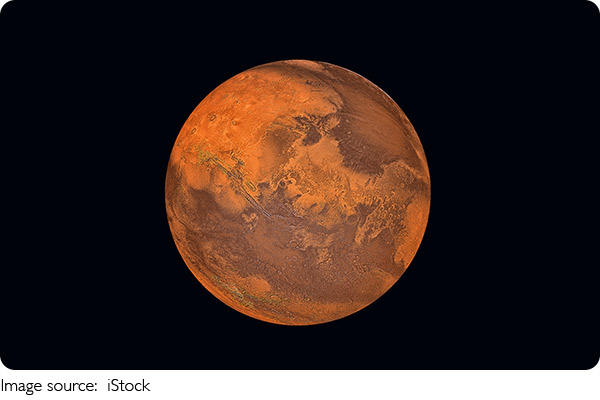
Mars did not become dry simply because its water vanished. Its transformation appears to have involved a chain of events connecting the planet's deepest interior to its atmosphere and surface: changes inside the core may have weakened the dynamo, the global magnetic field disappeared, atmospheric escape intensified, and Mars gradually became less capable of maintaining stable surface water.