How Guide Dogs Are Trained

Amina Hassan
| 11-05-2026
 · Animal Team
Guide dogs are far more than loyal companions. For individuals who are blind or visually impaired, these remarkable animals serve as a bridge to the world, enabling independence and safety.
From navigating busy streets to detecting obstacles, a guide dog's training is extensive and detailed. Training a guide dog requires more than just teaching obedience—it involves shaping their instincts and behaviors to ensure they're prepared for the life-changing task ahead.
Selecting the Right Dog
While theoretically any dog can be trained to assist those with visual impairments, certain breeds are better suited for the role. Retrievers are often chosen for their gentle temperament, intelligence, and ability to learn quickly. Border Collies are known for their keen awareness and focus, while Doberman Pinschers are favored for their minimal shedding, reducing grooming challenges for their owners. However, the most important factor is matching the dog's personality with that of its future owner. This careful pairing process considers temperament, size, and energy levels, ensuring a harmonious and effective working relationship.
The Early Stages of Guide Dog Training
The training process begins early in a dog's life. From the age of 8 weeks, puppies are placed with volunteer “puppy raisers” who care for them for the first year. During this period, no formal training takes place, but the puppies are exposed to various environments, sounds, and social situations. This stage is crucial for helping them develop confidence and social skills. Puppy raisers teach basic commands and ensure the dog is well-rounded and comfortable in a variety of situations. Although the role is unpaid, volunteers receive support from guide dog organizations, including food, veterinary care, and other necessities.
Advanced Training: A Year of Preparation
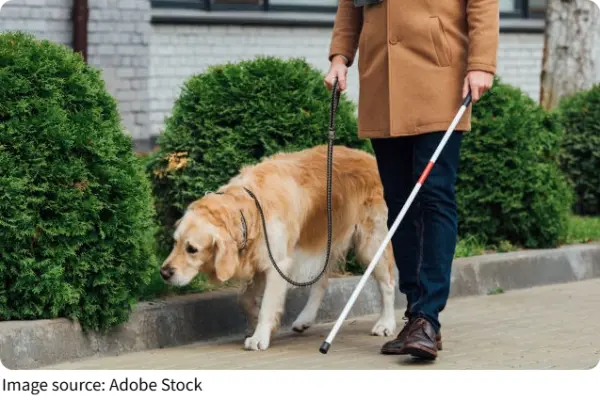
After the initial year with the puppy raiser, the dog enters formal training at a specialized guide dog school. It is at this stage that the dog learns to focus on its tasks and disregard distractions. The training involves teaching the dog to ignore other dogs, people, and noises while in “work mode,” a critical skill for navigating busy environments. Guide dogs are trained to respond to commands such as “left,” “right,” and “forward,” all while ensuring the safety of their owners. They are also taught to stop at curbs and avoid dangerous situations, such as stepping into traffic.
One particularly impressive aspect of guide dog training is known as “intelligent disobedience.” This refers to a guide dog's ability to ignore direct commands if it perceives a danger to its handler. For example, if a dog is told to cross a street but sees or hears an oncoming vehicle, it will refuse to obey, ensuring its handler remains safe. This decision-making skill is developed over countless training hours, making guide dogs truly invaluable companions.
Challenges During Training
While many dogs excel in their guide dog training, not all puppies make the cut. Approximately one-third of all guide dog candidates fail to complete the program. However, these dogs are often reassigned to other important roles, such as therapy dogs, search and rescue animals, or even family pets. For those who do succeed, their journey isn't over. Guide dog trainers continue to assess the dog's behavior and ensure it is ready for the responsibility it will carry.

The Life After Training
Once a dog completes its training, it is paired with a suitable owner, a process that can take several months. The match must be perfect, as the bond between guide dog and handler is crucial for success. Guide dogs typically work for about seven years before retiring, after which they may live with a foster family or continue to be a beloved pet.
Interestingly, some owners choose to keep their guide dogs after they retire. A touching example of this is the story of a British guide dog named Edward. After six years of service, Edward lost his sight due to glaucoma. His owner, Graham Waspe, chose to keep him as a pet, and they were later joined by a new guide dog. Together, the three continued to lead a life of shared companionship and trust.
The Cost and Impact
The cost of training a guide dog can be as high as $40,000, covering expenses such as veterinary care, food, and training equipment. Despite this, many organizations provide guide dogs free of charge to those in need. Charities, such as Guide Dogs of America, cover all costs, from flights for the handler to training sessions. In the UK, the cost to receive a fully trained guide dog is minimal, typically just a symbolic payment of 50 pence.
In conclusion, the training of guide dogs is a complex and multi-year process, but it is well worth the investment. These extraordinary animals provide life-changing independence for people who are visually impaired. They do not just guide—they save lives, foster confidence, and offer unwavering companionship. Their journey, from a playful puppy to a responsible and skilled working dog, is one of incredible transformation.