Fascinating Solar System

Pankaj Singh
| 08-04-2026
 · Science Team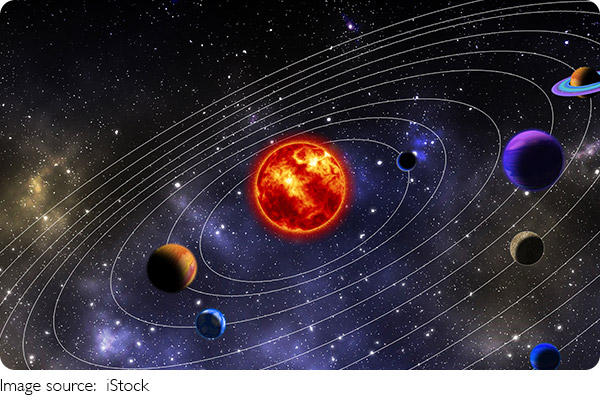
The Sun: Heart of Our System
The Sun is more than a glowing ball in the sky—it is the center of our solar system, holding 99.8% of its total mass.
Its gravitational pull keeps planets, asteroids, and comets in orbit. Solar flares and sunspots, often seen through advanced telescopes, demonstrate its dynamic nature. Interestingly, sunlight takes approximately 8 minutes and 20 seconds to reach Earth, meaning we are always seeing the Sun slightly in the past.
Planets with Unique Characteristics
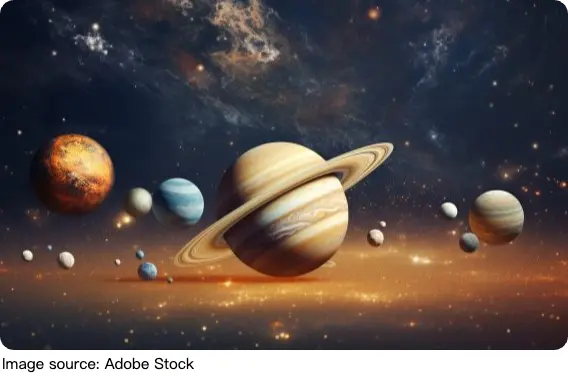
1. Mercury – The smallest planet, Mercury experiences extreme temperature swings from -173°C at night to 427°C during the day.
2. Venus – Known as Earth's “sister planet,” Venus rotates backward, meaning the Sun rises in the west and sets in the east.
3. Mars – The Red Planet has the largest volcano in the solar system, Olympus Mons, which stands nearly three times the height of Mount Everest.
4. Jupiter – Jupiter's Great Red Spot is a storm larger than Earth that has raged for centuries, showcasing the planet's turbulent atmosphere.
5. Saturn – Saturn's iconic rings are composed of ice and rock particles, some as small as dust grains and others as large as mountains.
6. Uranus and Neptune – These icy giants appear blue due to methane in their atmospheres, with Uranus uniquely rotating on its side.
Moons and Their Mysteries
Many planets have fascinating moons that reveal much about our solar system. Jupiter's moon Europa may harbor a subsurface ocean capable of supporting life, while Saturn's Titan has lakes of liquid methane and an atmosphere denser than Earth's. Even smaller moons, like Mars' Phobos and Deimos, are captured asteroids, offering insight into planetary evolution and solar system formation.
Asteroids and Comets
Asteroids are rocky remnants from the early solar system, mostly found in the asteroid belt between Mars and Jupiter. Comets, on the other hand, are icy travelers that develop glowing tails when they approach the Sun. The tail always points away from the Sun due to solar wind, creating spectacular displays visible even from Earth. Studying these celestial bodies helps scientists understand the origins of water and organic molecules that may have influenced life on our planet.
Exploration and Discoveries
1. Space Probes – Missions like Voyager, New Horizons, and Juno have provided invaluable data about distant planets and moons.
2. Telescopes – Observatories like Hubble allow astronomers to observe planets, nebulae, and distant galaxies in remarkable detail.
3. Robotic Rovers – Mars rovers, such as Perseverance, analyze soil, rocks, and atmospheric conditions to uncover signs of past water and potential life.
Reflection on the Solar System
Exploring our solar system reveals not only its vastness but also the delicate balance that sustains planets, moons, and smaller objects in orbit. Each planet and celestial body tells a story of cosmic evolution, offering clues about the origins of life and the universe itself. Observing these wonders encourages curiosity, imagination, and a deeper appreciation for the intricate beauty of space, reminding us that even our small world is part of an extraordinary cosmic dance.